RLX Workbench
03.2026 — presentlocal-first platform for rl experiments
Published on PyPI as rlx-workbench, currently at 0.4.0, Apache-2.0, Python 3.11 and up. It is a command-line workbench for running reinforcement learning experiments you can actually reproduce later.
Why
Most RL work I did early on lived in notebooks I could not rerun a month later. The hyperparameters were in a cell I had since edited. The plot came from a variable that no longer existed. Fixing that is unglamorous and worth more than most of the experiments it protects.
What it does
- — PPO experiment automation over Stable-Baselines3 and Gymnasium, configured in YAML rather than in code.
- — Checkpoints, metrics logging, eval artifacts, rendered video, plots, and structured run metadata written for every run.
- — An agent mode that turns a research goal in plain English into run inspection, analysis, variant generation, and a written report.
- — LLM-assisted planning through OpenAI or a local Ollama model, bounded by research.yaml and program.md so the automation stays auditable.
A run, end to end
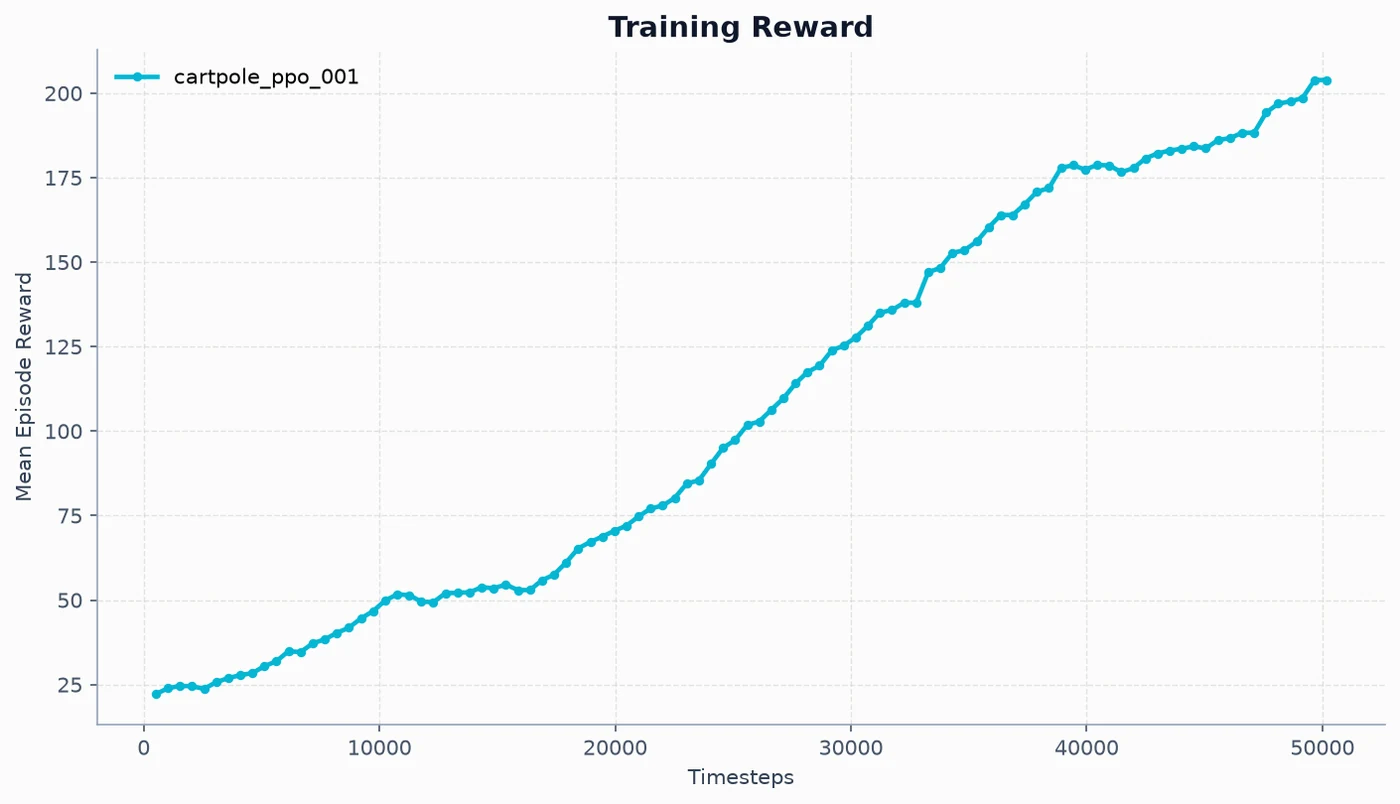
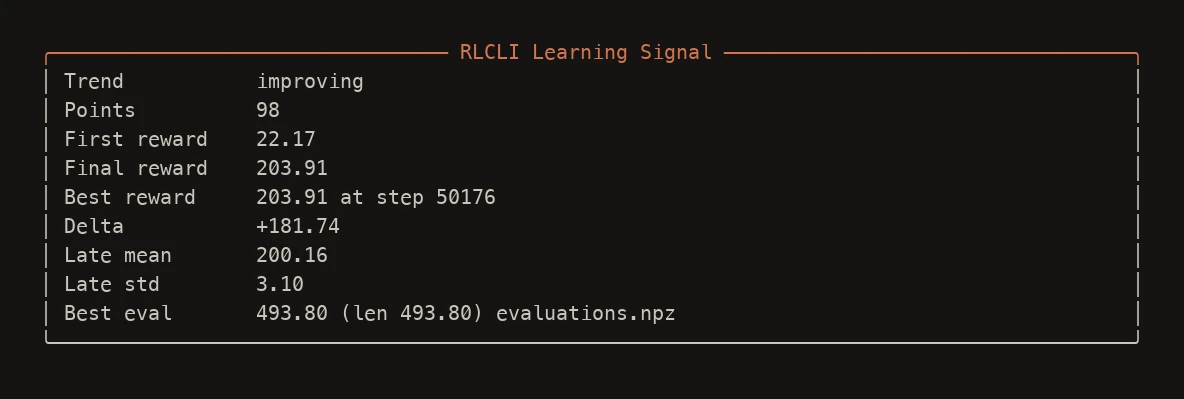
Install it, scaffold a project, and train against a starter config. This is CartPole-v1 for 50,176 timesteps on CPU: mean episode reward went from 22.17 to 203.91, and the best checkpoint evaluated at 493.80. Every number below came out of the tool, not out of a notebook I would have lost by now.